Posts

First Family of Woman Wrestling

Image
The Phogat sisters, all six of them, and their father Mahavir, will go down in the annals of sporting history as the unit which brought Indian woman wrestling to the international mat with singular rebellion and revolution.  MEENAKSHI RAO  catches up with this Haryanvi family to tell you why Dangal is an apt serenade to the sport & its propellers It is 4  am in Balali village of Bhiwani district. Daya Kaur, a hapless mother of four daughters and no son, is busy tending to the cattle, milking the buffaloes and cleaning up the brick and mortar house, as all other women in her locality. That’s Haryana for you in general, a deeply patriarchal society where women are meant only to bear kids, tend to the house and potter around closed confines fulfilling their men’s wishes, generally from behind long veils. Daya’s daughters are up too, at least the elder two, Geeta and Babita. And no, they are not assisting their mother in household chores. They do not have a chunni o...
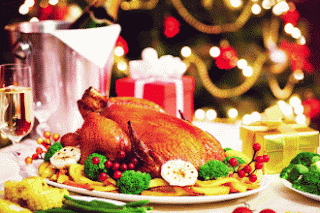
The Christmas platter

Image
It’s Christmas end of the year & time for yuletides, mistletoes, family supper, being together and joining in the festivities.  MEENAKSHI RAO  celebrates the occasion by running you through the food history of X’Mas along with recipes in a two-page special Stuffed turkey on the table, homemade cranberry sauce on the side, rum-soaked plum cake, mince pie, an array of breads adorning the candlelit table and a Christmas tree standing tall like Jesus guarding over the family — it’s that time of the year — family time, time to get back with near and dear ones, time to break bread over thanksgiving, time to be happy and feel belonged. While Jesus Christ’s birthday was earmarked for December 25 somewhere only in the 4th century after eons of debate, the sumptuous supper shared to celebrate the momentous occasion has a rich history in itself. Did you ever wonder where the rum-soaked tradition of the plum cake originated? Or, why is ginger such a celebratory spice for...

THE DHABA OF AUTHENTIC PUNJAB

Sweety Singh is a down-to-earth ‘true’ Punjabi chef with no cream, colour or kaju to add to his preparations. Punjabi food is not just an extra-rich winter plate, he tells  MEENAKSHI RAO  at the GT Road street food festival curated by The Claridges No cashew. No cream. No colour. That’s not good Punjabi food, you would say. The rolly-polly chef Sweety Singh vehemently differs. On a round to talk to his guests, know their preferences and ask them if the food is to their taste at the quaint Dhaba restaurant at The Claridges, Singh tells you he serves only healthy Punjabi food. “Healthy does not mean insipid. Healthy means the real Punjabi food, not the bastardised version that is being sold out of quick restaurants all over the world,” he says. Meaning what? “If you go into the history of Punjabi food, you will find it to be a simple, healthy and everyday rural platter rich in nutrients. I am here to propel the original Punjabi food which has the love of a grandmother an...

CHIKUNGUNYA OR WHAT?

As Chikungunya rages, turns fatal and makes a mockery of health and hygiene in India's Capital,  MEENAKSHI RAO  delves into the disease from a patient's point of view It was in the early 2000s that I first heard of the term Chikungunya . It had broken out in and around the Gorakhpur-Ballia-Basti belt of east Uttar Pradesh. Ah, I thought then. So here comes another one of those unknown epidemics from a region which has gained notoriety for large-scale populace ailments over the years. Though scores of people were hit back then, the blazing epidemic hardly ever made it to page one in any national English dailies, after an initial mention. In school, which was relatively nearer to this ailing area than Delhi, being in Lucknow, I had often learnt the name of epidemics from this chronic belt. Meningitis, I remember, was one such dreadful outbreak. Hordes, mostly children, died before the news died. Then there was Filaria, that Elephant Foot disease. It all used to happen do...

CHIKUNGUNYA: ‘HOMOEOPATHY HAS REMEDY’

Alternative medication has been working on patients gripped by the current strain of chikungunya-like virus. However,  MEENAKSHI RAO  talks to reputed homoeopath  DR MOHAMMAD QASIM to find out how the treatment has to be completely customised to individual patients even though the symptoms are the same. Excerpts of the interview Why is homoeopathy working and not allopathy? This is because in allopathy only painkillers are being given. They may control the pain but the remnants of viruses remain in the absence of a healing medicine. Homoeopathy , on the other hand, looks for a diagnosis based on the body responses to the disease of every patient individually. Our medication identifies the virus and then prepares the body to tackle it. We heal clinically, hence we are more equipped to hit the virus. We prepare the human body to develop its own defence mechanism and then fight the virus. So we cure instead of merely containing. But chikungunya is a modern-day dis...

DIPA VAULTS TO GLORY

Never mind Dipa Karmakar. You did not get a medal at the Rio Olympics but you did the impossible. At the stroke of midnight on Independence Day, you changed India's tryst with destiny to its tryst with amazing, incredible, liberating effort. On a manic Sunday when much bigger stars from India were falling like ninepins, when the largest contingent ever to be sported by India was looking bleak and bankrupt, a 23-year-old hitherto unknown gymnast from Agartala won as no other athlete who loses a medal can or ever will. The unassuming artistic gymnast did what no one expected her to: First, she qualified for the Finals of the difficult Vault event ranked eighth on the list and then she missed a Bronze medal by a whisker — just the minutest of .15 points. After her twin vault performance, she briefly stood at the Silver medal spot with an aggregate score of 15.066 with world champion Simone Biles and Russia's Maria Paseka yet to perform. With Biles lifting the Gold (15.96...

ICCWorld Twenty20: Windies bundle out India

MUMBAI: Without a contribution from Chris Gayle, running high on the blades of Lendl Simmons, J Charles and Andre Russell preying comprehensively on all Indian bowlers, West Indies achieved the improbable — they bundled out India from the World Cup to reach Kolkata for the Final against England. As efforts go, this one was superlative. It came from a corner, on a big score, without the main West Indian weapon, in front of a very Indian crowd and with a confident knock from the lesser sung heroes of the Caribbean team. West Indies flowered on the fire power of solid partnerships, confident and aggressive knocks and an absolutely scintillating show by Andrew Russell and Lendl Simmons who was in the tournament for the first time as a replacement to the hamstrung Fletcher. But he showed no rust or jetlag whatsoever with the bat and carried his team to the Final on his high knock of an unbeaten 83 in some 50 odd balls. At no time in the West Indies innings were India on top, except ...